Why a Spoonful of Water Can Make a Mirror Fog
Why a spoonful of water can make a mirror fog: learn how moisture and cool glass create condensation, and choose a sensible way to clear it.
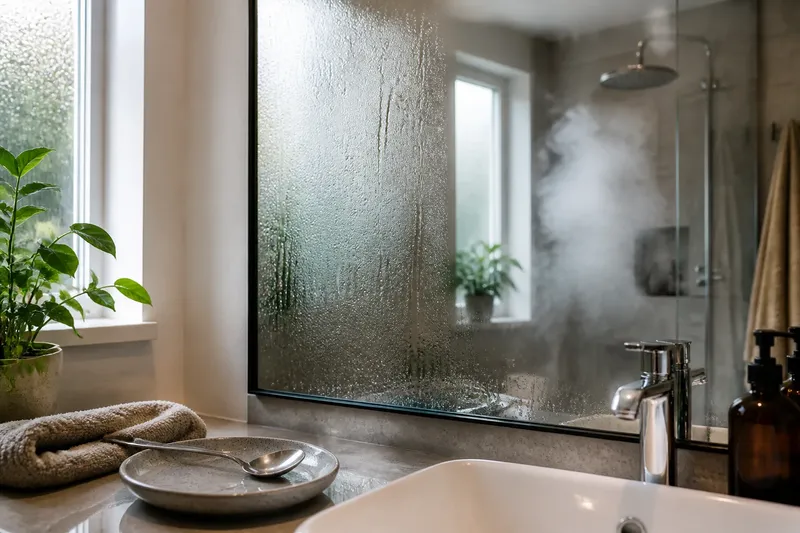
You set a warm mug beside the bathroom basin, run the tap, and watch the mirror turn cloudy. The glass has not absorbed moisture like a sponge: water from the air has gathered on its cooler surface. Why a spoonful of water can make a mirror fog comes down to a simple distinction: invisible water vapour is not the same as visible liquid droplets.
What makes water in the air turn visible?
Air can contain water in its gaseous form, called water vapour. The vapour itself is invisible. When some of it changes into liquid water, tiny droplets can scatter light. A dense layer makes the mirror look pale and blurred, even when the droplets are too small to see individually.
This change from gas to liquid is condensation. It occurs when moist air cools enough for some of its water vapour to condense. The relevant temperature is called the dew point: the point at which the air, under the conditions around it, can no longer keep all its water in vapour form.
The dew point depends on how much water vapour the air contains. Air with more moisture can reach condensation conditions while warmer than drier air. In a bathroom, a shower adds moisture, while the mirror may remain cool from the surrounding air or the wall behind it.
The mirror makes condensation easy to notice. It cools the thin layer of air next to it. If that layer reaches the dew point, some vapour changes into droplets on the glass.
Why does the mirror fog before other surfaces?
A mirror is not necessarily the coldest object in a bathroom, but it often provides a broad, smooth surface at a different temperature from the warm, damp air. Moist air from a shower meets the cooler glass, loses heat, and can leave droplets behind.
Some surfaces make those droplets easier to see. On glass, water may gather into small beads or a thin, uneven film. These disrupt the light that would otherwise reflect clearly, so your reflection softens or disappears. A tiled wall can also collect condensation, but its texture and colour may make the moisture less obvious.
Droplet size and spacing affect the appearance. A fine haze can obscure much of the mirror; larger beads may leave clear patches between them. The fog is not steam trapped inside the glass. It is liquid water resting on the room-facing surface.
Wipe a small patch with a clean, dry cloth. If the reflection returns there and the patch later clouds over again, the moisture is on the surface and the surrounding air is still damp enough for condensation.
What does a spoonful of water have to do with it?
A spoonful of water can contribute moisture to a small room, but its effect depends on how it gets into the air. Liquid water does not turn into vapour just because it is near a mirror. Some molecules at its surface escape into the air through evaporation, encouraged by warmth and by air movement that carries vapour away.
In an ordinary bathroom, a shower is a more obvious source of added moisture than a spoonful left in a dish. The spoonful helps illustrate that even a small amount of liquid can supply some vapour, but it does not create fog by itself. The necessary combination is moisture in the air and a surface cool enough for condensation.
Imagine a bathroom where a spoonful of warm water sits in a shallow dish while the mirror remains cool. If some water evaporates and the room air becomes moist enough, a faint haze could form; if the air remains dry, the mirror would stay clear. The result depends on room conditions, not simply on the water in the dish.
Should you warm the mirror, dry the air or wait?
There are three everyday ways to think about a fogged mirror: warm the glass, reduce moisture in the air, or let the bathroom air and mirror settle towards similar conditions. Each addresses a different part of the process.
- Warm the mirror. A warmer surface is less likely to cool the air beside it to the dew point. This may suit a mirror that repeatedly fogs during a shower, provided it has a purpose-made demisting feature fitted and used according to its instructions.
- Reduce damp air. Ventilation carries moist air out and allows drier air to replace it. Opening a window or using an existing extractor fan may help a bathroom that stays humid after bathing, depending on the room and its ventilation arrangements.
- Wait for conditions to change. As the room airs and the mirror warms, condensation can evaporate. This may suit a brief episode when you do not need the mirror immediately.
Wiping the glass is a temporary option: it removes droplets but does not remove moisture from the air. If the mirror remains cool and the air damp, condensation may return.
Notice whether the fog disappears as the room airs. A recurring problem during showers may ease with ventilation; persistent dampness calls for attention to the room’s ventilation rather than repeated wiping.
Which mirror-clearing approach fits your bathroom?
Does a heated mirror stop condensation?
A heated mirror raises the glass temperature, making condensation less likely on its surface. It may suit a frequently used bathroom, but choose a product designed for that purpose and follow the manufacturer’s installation and operating instructions.
Will opening a window clear a fogged mirror?
Opening a window can help carry moist air outside, particularly when the outdoor air is less humid than the bathroom air. The effect depends on outdoor conditions and the room’s layout, so the mirror may not clear immediately.
Why does a mirror fog even when the room feels warm?
Room warmth does not mean every surface is equally warm. A mirror can remain cooler than the surrounding air, and moist air touching the glass can cool enough for vapour to condense.
Why do droplets appear after I wipe the glass?
Wiping removes existing water but does not change the mirror’s temperature or the moisture in the air. If those conditions still favour condensation, new droplets can form on the cleared patch.
How can you choose between these options?
Start by noticing when the fog forms and how long it lasts. If it appears during a shower and fades as the room airs, ventilation and patience may be enough. If the mirror fogs often and you want it clear while bathing, a suitable demisting mirror may address the cool surface directly.
If the bathroom remains damp well after use, focus on moving moist air out rather than treating the mirror alone. Use an extractor fan as intended. Persistent dampness or ventilation problems may merit advice from a qualified building professional; follow product instructions and local requirements where they apply.
For a simple decision, ask whether the main issue is a cool mirror, lingering humid air, or a brief cloud of droplets. Warming the glass addresses the cool surface, ventilation helps with lingering moisture, and waiting or wiping can suit a short-lived haze. The practical point is straightforward: a clear mirror depends on the balance between the glass temperature and the moisture in the air beside it.