The Pocket Notebook or the Loose Index Card?
Pocket notebook or loose index card: choose a simple way to catch passing questions, preserve their context and rearrange ideas when connections appear.
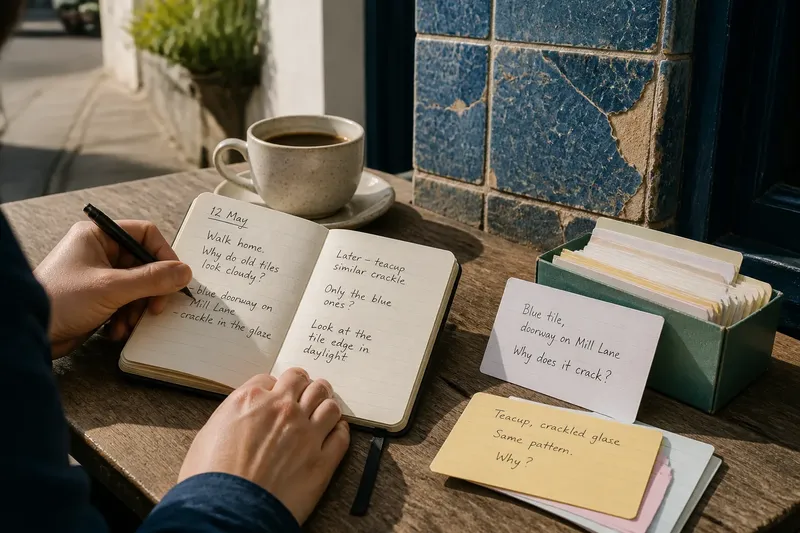
You notice a chipped blue tile on the walk home and wonder why its glaze has a fine crackle. A pocket notebook can keep that question beside what you noticed next; a loose index card can give it room to move when another question joins it. The choice between a pocket notebook and loose index cards is less about neatness than about what you want a captured thought to do.
What does a notebook keep together?
A notebook gives passing questions a sequence. The tile question sits after a note about a bakery window and before a reminder to look up a street name. That order may be accidental, but it preserves the small circumstances in which an idea arrived: place, company, weather, or whatever else you happened to write down.
This continuity helps when a question is still taking shape. A line such as “Why do old tiles look cloudy?” can acquire a second line later: “Only the blue ones on this doorway?” The page shows the question changing rather than presenting a polished subject that never existed in that form.
A notebook also asks little of you at the moment of capture. Open it to the next blank space and write. You do not need to decide whether the note belongs with architecture, materials, or a future conversation before letting it escape your memory.
For a notebook that travels in a coat pocket, choose a size and binding that open comfortably for you. Leave a little space between entries, or mark a fresh thought with a dash or date. The aim is not a pristine archive; it is a page you can scan without mistaking one question for the next.
Why can cards make ideas easier to rearrange?
An index card separates one thought from its neighbours. That physical separation makes sorting tangible: place a card about cracked glaze beside one about old pottery, move it to a pile on building materials, or set it aside until the connection becomes clearer.
Cards suit questions that may develop into clusters. You could keep a single question on one face and, on the reverse, add a clue, a source to consult, or a new question prompted by the first. A small stack can then become a changing map of curiosity rather than a record of when each thought occurred.
The trade-off is that a loose card can lose its context. “Why does it crack?” is hard to recognise after the doorway, tile and walk have faded from memory. Include a few identifying words—“blue tile, doorway on Mill Lane”—so the card remains intelligible when it is moved or rediscovered.
Cards also need a home. A box, paper band or sturdy envelope can keep them from slipping into a bag or drawer, but the storage should be easy to reach. If putting a card away feels like a separate chore, the question may never make it onto one.
Which format fits the life of a question?
Think about whether you value the path of a thought or its possible neighbours. A notebook is especially useful when observations arrive in sequence, when you want to browse an entire afternoon’s notes, or when one entry often sparks the next. Cards are useful when you expect to group, compare, reorder or set aside ideas without rewriting them.
Neither format has to carry every kind of note. You might write a quick observation in a notebook and make a card only when it grows into a subject worth arranging. Or keep cards for questions that need sorting, while using a notebook for the scenes and stray details that give them context.
Say you jot down a question about the blue tile in a notebook, then later notice similar crackling on a teacup. You could add the teacup beside the original entry to preserve the discovery’s sequence; if you want to compare the surfaces, copy each observation onto its own card and place them together. The expected visible result is different: one page tells how the thought unfolded, while the small group of cards makes the comparison easy to see.
How can you make either system easy to revisit?
Use a few stable cues rather than building an elaborate filing scheme. A date can locate a notebook entry in time; a short subject word at the top of a card can help you sort it. Keep wording concrete enough to recognise later, and record an immediate next action only when one exists, such as “look at the tile edge in daylight”.
- For a notebook: number or mark pages if you often return to older notes, and leave room for a small index if useful.
- For cards: write one main question per card, so moving one thought does not pull an unrelated one with it.
- For both: include the object or place that prompted the question, not just an abstract “why?”.
- For regular review: keep the notebook or card container somewhere you naturally pause, such as beside a reading chair.
- For unfinished ideas: distinguish a question you still care about from one that was simply a passing curiosity; a small mark is enough.
These are prompts, not rules. If a page fills with several unrelated ideas, that may be useful evidence that you prefer cards for sorting. If a stack becomes difficult to interpret, the notes may need more context—or a notebook may better suit how you think.
What do readers often ask about notebooks and cards?
Are index cards better for brainstorming?
They can help when you want to move ideas around and see possible groupings without rewriting a page. A notebook may suit brainstorming better if the order in which thoughts emerged matters to you.
How much should I write on one card?
Write enough to recognise the question and recall its setting, then add a clue or next action if it helps. A card need not hold a complete explanation; its job may be to bring the thought back to mind.
Can a pocket notebook replace a phone notes app?
It can hold handwritten observations and questions, but it will not offer the same search or sharing functions as a phone. Choose the tool that is available and comfortable at the moment a thought occurs.
How do I stop loose cards becoming a mess?
Give them one reliable container and use a small number of plain categories, such as “open questions” and “to revisit”. If sorting starts to take more attention than the questions themselves, reduce the categories or keep a notebook instead.
What is the simplest way to choose?
Try noticing what you do naturally after writing a question down. If you reread the nearby entries to recover its setting, a pocket notebook may be the better fit. If you want to lift it from the page and compare it with other subjects, loose cards make that movement easier.
The pocket notebook or loose index card decision need not become permanent. Keep one format within reach for a little while, and pay attention to whether you return to the notes or avoid them. A useful record is not the one with the tidiest pages; it is the one that lets the question become visible again when you are ready to follow it.