A Window Seat for Watching Clouds
A window seat for watching clouds turns a grey afternoon into a calm observation routine, helping you notice shape, movement and changing light.
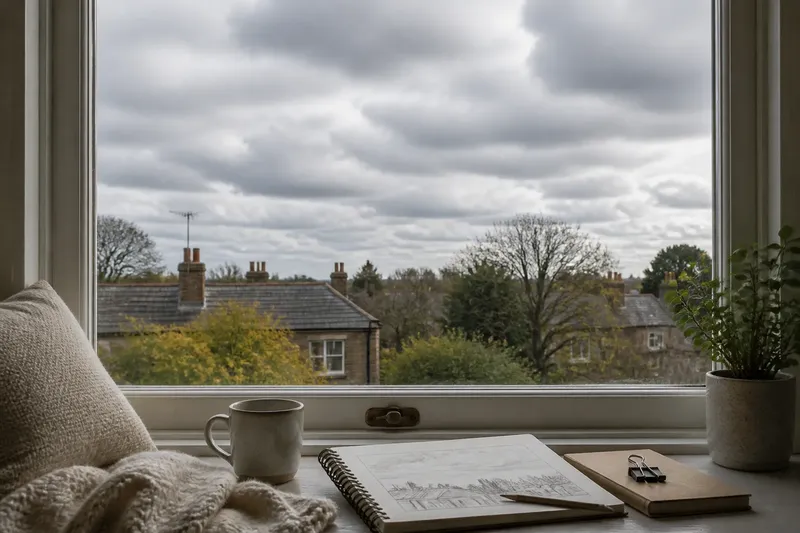
Rain has stopped, but the sky beyond the kitchen window is still a sheet of grey, and the kettle is taking its time. A window seat for watching clouds gives that pause a gentle purpose: observe what the clouds look like, then notice how their shapes and positions change, without turning the exercise into a weather forecast.
The activity works best as a small routine rather than a vigil. A few brief visits to the same view can reveal patterns that a single glance misses: a ragged edge softening, a darker patch sliding behind a roof, or separate forms merging into one broad layer. The point is not to name every cloud correctly. It is to pay attention to change.
Why return to the same window?
A fixed viewpoint makes comparison easier. Choose a window that offers a safe, comfortable view of open sky, perhaps with a distant roofline, chimney or treetop as a reference. Those familiar features help you notice whether a cloud has shifted, while keeping the scene grounded when the sky itself looks featureless.
Settle where you can look without craning your neck. If the window seat is cold, use a chair nearby and a blanket; comfort helps the activity remain restful rather than becoming a test of patience. Leave the glass closed, especially in chilly or wet weather. You can observe cloud forms just as well through a clear pane.
Keep a pencil and a small piece of scrap paper nearby if you enjoy making a record. A sketch need only be a few lines: the window frame, one recognisable landmark and the main cloud boundary. If drawing feels like work, simply choose a phrase such as “soft band above the trees” and hold it in mind.
How can you shape a grey-afternoon routine?
Use the afternoon as a series of short visits, with ordinary activities between them. The gaps matter: they give the sky time to change and stop you from staring until every small variation seems meaningful.
- At the first pause: Look out for a moment and describe the broad arrangement. Is the sky covered evenly, broken into patches, or divided between lighter and darker areas?
- After a kettle boils or a page is read: Return to the same spot. Find one cloud edge or patch and compare its position with a fixed feature outside.
- During a later indoor break: Notice whether the forms look sharper, softer, joined together or less distinct. Attend to the edges as well as the overall grey.
- Before leaving the window: Look once more without trying to reach a conclusion. If you have been sketching, add a final line or a note about what changed.
There is no need to follow exact intervals. A visit after lunch, another while something is cooking, and one before the room darkens may be enough. If the clouds appear unchanged, that is still a useful observation: the view has held its form across your returns.
What should you look for besides shape?
Clouds can be described through a few ordinary features. Shape refers to whether a form is rounded, stretched, broken or spread into a layer. Texture describes whether its surface appears smooth, lumpy or frayed. Light and shade can make the same cloud seem flat at one moment and sculpted at another.
Movement is easiest to notice by comparing a cloud with something that stays put in the view. Pick a roof corner, aerial or tree branch, then see whether the cloud’s edge appears in a different place when you look again. The apparent movement may be slow, and the edge may change shape as well as position, so avoid treating one landmark as a precise measuring tool.
Also notice what happens to the gaps between clouds. A narrow strip of pale sky may widen, close, or shift to one side. If there is an unbroken layer, watch for uneven brightness instead: a lighter region may drift across the view even when you cannot pick out separate cloud boundaries.
How can a small sketch make comparison easier?
A quick drawing preserves the arrangement you saw without demanding technical skill. Use the paper in landscape orientation, mark the horizon or a building outline, then draw only the largest cloud shapes. Leave out detail that you cannot easily see. Add a short note such as “thin edge over chimney” or “dark patch joined the wide layer”.
Say you begin with a broad grey band sitting above the roofline. Later, you return and see that a ragged section now hangs lower while a pale opening has appeared near the tree. In your sketch, you could keep the roofline fixed and redraw those two features in their new positions. That comparison records a visible change; it does not tell you what the sky will do next.
Keep the paper beside the window rather than trying to draw while moving around the room. If light is poor, rely on outlines rather than shading. A few readable marks are more useful than a detailed picture made by guessing.
What questions help you observe clouds?
How often should I look outside?
Return when it fits naturally into the afternoon, leaving a little time between visits. The aim is to compare separate impressions, not to watch continuously.
What if the sky looks completely uniform?
Notice small differences in brightness, density or the line where the cloud layer meets the buildings. If nothing seems to change, record that impression and come back later if you wish.
Do I need to know cloud names?
No. Everyday descriptions such as “wispy”, “lumpy” or “flat” are enough for this activity. Cloud names can be interesting, but identification is not required to observe movement.
Can I do this when the view is partly blocked?
Yes, if you have a clear patch of sky and one stable feature to use as a reference. A tree or neighbouring roof may hide part of the view, but it can also make gradual changes easier to notice.
When is it time to stop?
Stop when the activity feels complete, not when the sky offers a dramatic transformation. You might have noticed one cloud break apart, watched an edge fade, or simply found that the view remained much the same. Close the notebook, put the pencil away and return to whatever you were doing.
If the afternoon grows dim, use the change in room light as a natural ending rather than leaning towards the glass to see more. The window seat for watching clouds is most satisfying when it leaves you with a clearer memory of a small, ordinary scene, not a prediction about what comes next. On another grey day, you can begin again with the same window and a fresh description.